Tuesday, August 13, 2013

Big Island of Hawaii #3 - Tropical Rainforest and Waterfalls


Nature on Hawaii Island (Big Island) is diverse; sunshine beaches, volcanic landscapes, rain forests, and a 13,803 foot high mountain.

The east side of the Big Island is located in the rain shadow with annual rainfall 150-250 inches. Abundant rain falls and with its year-round warm climate, the vegetation grows very well. The thick greens of the rainforest which includes typical jungle trees with draping vines; banyan trees, palm, ferns, and mosses cover the area.

There are numerous waterfalls throughout the Big Island's rainforest. Akaka Falls is one of Hawaii's iconic landscape images. The water drops 422 ft vertical down a moss and fern covered cliff, and its spray creates rainbows near the bottom. Just like paradise imagined...

100-foot Kahuna Falls are cascading through lush green cliff.

Beach is nice, but I'm more attracted to unique natural landscapes on the Big Island of Hawaii.

When I got back from Hawaii in early June, Spring had finally arrived in Alaska. Green vegetation was a welcoming sight. Summer is the most beautiful time in Alaska and a busy season for a nature photographer. I'll share some of new photos from Alaskan wilderness on the next posting.


Tuesday, August 6, 2013

Big Island of Hawaii #2 - Hawaiian Green Sea Turtles (Honu) at Punalu'u Black Sand Beach

 
The Hawaiian Green Sea Turtles ("Honu" in the Hawaiian language) are sacred creatures in ancient Hawaiian legend, and a significant symbol of the Hawaiian Islands. Native Hawaiians worship the Honu as their ancestral spirit guide whose wisdom protects and leads them throughout their lives. Hawaiian Green Sea Turtles are protected under the Endangered Species Act.

Punalu'u Black Sand Beach on the Big Island is one of the spots where you can find those Green Sea Turtles out basking on the beach. It was in the evening when I first saw two large turtles laid out on the shore, mostly with closed eyes, and stayed at the same spot overnight. They are huge; a typical adult green sea turtle has a outer shell length of 40 inches and can weigh from 200-500 lbs. Their life spans around 70-80 years!

This huge turtle was sleeping on this rock until sunrise.

Some turtles were stuck in the tide pool... They were waiting for the incoming tide to opens up the waterway to the sea.

Turtles kissing.

Besides the turtles presence, Punalu'u Black Sand Beach has a magical atmosphere; the jet black sands, formed from the volcanic lava, surrounded by picturesque coconut palm trees. Behind the beach lies a freshwater pond with water plants adding yet another interesting landscape.

This story will continue in the next blog: Big Island of Hawaii #3 - Tropical Rainforest and Waterfalls

Tuesday, July 9, 2013

Big Island of Hawaii #1 - Hawaii Volcanoes National Park


In late May while it was still spring in Southcentral Alaska, I flew to Hawaii for the first time. I've been focusing on northern wilderness and alpine landscapes for most of my photography career while living in Alaska for the past 3 years. 


The tropical environment of Hawaii with its wild volcanic landscape gave me a new appreciation of nature. The Big Island (Hawaii) offers almost every form of nature; from the dynamic Hawaii Volcanoes National Park, the snow-capped Mauna Kea, the tropic rainforests, countless waterfalls, the black sands beach, to the island’s own unique wildlife. There were just too many things to see and experience during the 2 weeks I visited.


Hawaii Volcanoes National Park was one highlight of the trip of which there were many. The park includes two active volcanoes: Mauna Loa, which last erupted in 1984 and Kilauea which has been erupting since 1983. Acres after acres of lava flow, craters, and lava tubes make this National Park a must see. The volcanic eruptions are not as active as in years past, but Halema'uma'u Crater at the summit of Kīlauea still sends out red hot magma. The plume glow illuminates the night after sunset and yet the stars above were still unbelievably bright in the clear night sky.


Here are the old lava flows which engulfed subdivisions of Kalapana. This kind of lava field goes on for miles and miles offering amazing a glimpse of nature's abstract art. (Sorry to those who lost homes).


New life grows in the cracks of the old lava flow.


The trail ended at the black sand beach.

This story will continue in the next blog: Big Island of Hawaii #2 - Hawaiian Green Sea Turtles at Punaluu Black Sand Beach


Monday, May 27, 2013

Chugach Mountains, Alaska


The long winter is finally ending, daylight gets longer and longer each day... Finally the snow is melting in the northern wilderness. Time to get out and explore!

Chugach Mountains stretch from the Canadian border to Southwest Alaska. The mountain range contains dynamic landscape including high peaks, alpine lakes, glaciers, salmon streams and abundant wildlife. Chugach Mountains, especially outside of Anchorage, are a popular destination for outdoor enthusiasts, and of course, nature photographers!

During the spring melt, mother nature creates amazing art... I love the textures of ice sheets over  creeks.
 
The snow dusted over the icefalls, meting water runs down behind the icefalls.
 
Another spectacular landscape from Eklutna Lake.  Finally, the lake starts the spring melt in mid May.

January Sunset over Chugach Mountains and Knik Arm in Cook Inlet.

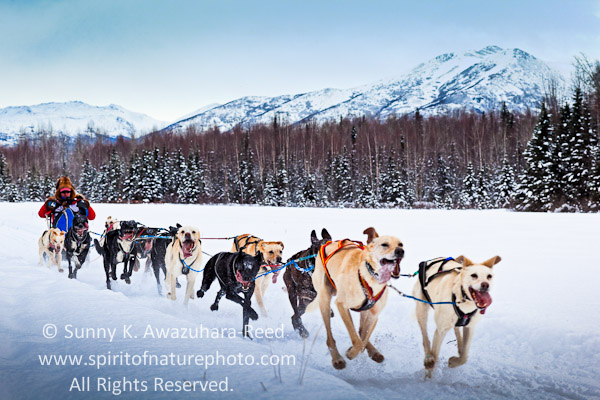
A sled dog team runs through Chugach Mountains.
 
Chugach Mountains over Anchorage at Sunset.

I can't wait to see and photograph beautiful fresh greenery in Chugach's outstanding landscape soon.

Saturday, March 16, 2013

Northern Lights over Anchorage

 
The winter season 2012-13 were among the best to view northern lights due to high solar activity. Northern lights most often appear in the high latitudes around the Arctic region. When I lived in Fairbanks (300 miles south of the Arctic Circle), I witnessed the aurora several nights a week during the winter months. Now I'm in Anchorage, 300 miles south of Fairbanks where the aurora displays are rare. When the solar activity is strong, occasionally the northern lights dance above Anchorage and the southern region of Alaska.
 
It was on one of these rare nights following a magnetic sun storm that bright green aurora waved above the city! I happened to see the lights from my front door in a residential area of East Anchorage around 8pm. The lights must have been very intense to be visible with the city lights.
 
On another day, the aurora glowed brightly above Cook Inlet in south Anchorage.
 
Spring is approaching Alaska after the long winter months. The days are getting longer every day (+5 min each day in Anchorage) The darkness is soon to give way to long days in the land of the midnight sun. The season of the northern lights will soon be over...

Sunday, February 3, 2013

Denali Sunset

In the mid July, I went camping in Denali National Park to photograph Mount McKinley, or Denali as it is known to Alaskans, the highest peak in North America.

It was overcast in the morning when I entered the park via the park shuttle. Unfortunately, Denali (Mt. McKinley) is often hid behind clouds during the prime summer season. At an elevation of 20,328 feet high, the mountain generates its own weather.

After several hours on the park's only road, I arrived at Wonder Lake Campground, at Mile 85. The campground's location offers a broad-side view of Mt. McKinley. However, most of the early part of the day revealed only gray clouds as background. It was cloudy all afternoon while hiking the McKinley Bar Trail to the river and back. I didn't expect to see the any of the mountain that day.
Around the time when I arrived back at the campsite that evening, the clouds started moving and created some windows. Part of the mountain peak began appearing. It was in mid summer in the interior Alaska with over 20 hours of day light when the mountain slowly revealed itself.
In just a few hours, the veil was gone; Mt. McKinley was out! The clouds moved away and by late afternoon the sun also came out. In the northern latitude, sunset takes a long time... which is a photographers dream! The lower-angled sun lit up the mountain with golden orange light. As the sun slowly shifted above the horizon, McKinley was aglow in pinkish orange for quite some time.

Mother nature sometimes shows us magnificent and beautiful views.
 

Tuesday, January 22, 2013

Mammoth Cave National Park, Kentucky

 
I've been fascinated with the mysterious underground world since I first visited caves in Japan in my childhood.  Mammoth Cave, the world’s longest cave system extends over 390 miles (630 km) of passageways and continues to grow with each newly-discovered section.
 
In mid-January, while taking a short break from the cold Alaskan winter, I flew to the Midwest for a mini vacation.  Finally, my childhood dream, exploring Mammoth Cave, came true.  Kentucky was also in the mid of winter as most trees had lost their leaves.  It rained both days while I was in the park, but I spent two days in the cave where the only water falling was tiny trickles in only a few areas of the cave. The temperature is a steady 54 degrees year round inside the cave.  The National Park Service offers several guided Cave Tours but self-guided is not an option. Cave visitors have to take one of the many guided tours to see the cave.
 
Photographing natural cave is challenging and must be done in low light conditions.  Time exposures are a must, however, neither tripods nor monopods are allowed to use in Mammoth Cave.  What a photograph   killer!  So I set up with high ISO, 6400 in order to get shots while handholding.  Using the handrails for support, image stabilization lens, and my steady hands, the shutter speeds were still very slow.  Plus being on a guided tour, I didn't have enough time to compose satisfactory images.
I joined 3 guided tours, and photographed as best as I could.  Many images are not as sharp for my standards...  but here are some images anyway.
 Natural Cave Entrance
Famous formation: Frozen Niagara
 
"Bacon" formation