Monday, May 30, 2011

Sitka National Historic Park, Alaska

It was raining when I spent a whole day exploring Sitka National Historical Park.  As the park is located at sea level, it was a bit greener than the mountain trail I hiked the day before.  When it's wet, the green is brighter than ever.  It was still early spring; the red alder trees were still naked without leaves. 
Walking in the rainforest, I often hear the raven's song echoing from somewhere deep in the woods.  Weathered totem poles stood along the trail, which perfectly blended in the old growth woods. Walking in this rainforest was a spiritual... it somewhat reminds me of an old shrine in the deep forests in Japan.
The trail opened up to the coast.  Numerous small islands covered with trees are scattered around the Sitka Sounds... nobody around in this quiet little cove.

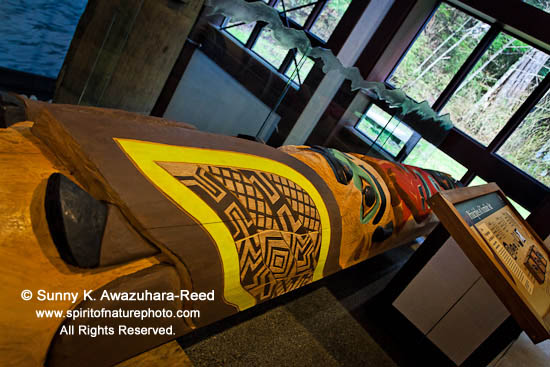
Sitka National Historic Park celebrated its 100th year anniversary in 2010.  It's the oldest National Park in Alaska.   Celebrating the Centennial Year, National Park Service commissioned the special totem pole with the master carver Tommy Joseph.  The totem pole represents Sitka and the surrounding area and the National Park Service.  It contains a buffalo (a symbol of the National Park Services), an old Russian marker plate, the native plants (skunk cabbage and devil's club), two salmons, and a spiritual woman's face.  Its light green and yellow colors are non-traditional for the totem pole.  The pole, almost finished, lays at the Park Visitor Center for the raising ceremony on May 15. Too bad I missed the pole raising by a week!
On my next posting, I'll write about  Michio Hoshino's totem pole, which is the memory of the famous Japanese photographer killed by a bear in 1996.

Sunday, May 15, 2011

Sitka: "The Most Beautiful Southeast Alaskan Town"

 
The misty rain enveloped the passage between forest covered islands... It's typical weather in Southeast Alaska region: one of my most favorites area. The Alaska Marine Highway ferry from Juneau arrived to Sitka in the afternoon when my adventure began.
Sitka is located on Baranof Island, about 150 miles south from Juneau. Like other Southeast Alaskan towns, Sitka is surrounded with green moss covered rainforest, glacier carved waterways, and snow capped mountains in the back drop. "Alaska's the most beautiful town" how many times I heard about this... so I'm here to see.
Sitka also has the rich history. It was an old capital for Russian Alaska, and the capital of the territory of Alaska after the United States bought Alaska from Russia, until Juneau became the state capital in 1906. There are some old Russian buildings remains throughout the town. Tlingit Native cultures are still deeply rooted in Sitka: totem poles and Tlingit carvings are scattered over the town.

I was hiking through the rainforest to the alpine ridge, through the wet meadow to the rocky coast, all under the overcast sky and in a misty rain. It was early in the season, the greens starting to appear among the brown grass. There was still snow high up on the mountain trail.
After half a year of living in the interior Alaska, I'm back in the rainforest in Southeast Alaska...for a short while. Surrounded with moss drenched tall trees, the smell of the ocean, and the sound of raven songs... plus hilly old towns... I love the Southeast Alaska!
Here is the Sitka's natural landmark, Mount Edgecumbe; it reminds me Mount Fuji in Japan.

(This story continued to next posting...)

Saturday, April 23, 2011

Blaze in the Zenith: The Northern Lights

Spectacular Northern Lights occur at the time of magnetic storms, and when the sun's activity releases solar flares.
In early March, another amazing Aurora was displayed for two nights! The lights were very bright; clear and vivid even in the southern parts of Alaska!

Here in the interior Alaska, right below the Arctic Circle, the brilliant neon green was a waving tapestry of light draped across a nearly full moon.

The huge zenithal fires blazed the entire sky with the edges displaying a rarely seen purple color! The amazing Northern lights show went on and on... At its zenith, the Aurora corona appeared like fireworks!
In older times, Alaskan Natives believed countless myths about the Northern Lights. Many of them feared the active display of the Aurora. Some believed that the Aurora were the spirits of dead ancestors playing a ball game with a walrus skull. Interesting, isn't it?

My short photography excursion will be coming soon. I'll take another Alaska Marine Highway ferry from Whittier to Juneau at the end of April offering many opportunities for dramatic landscapes. I will then explore Sitka, an historic southeast Alaska town, for a week in early May. I'll keep updating new photos and stories in this blog. Please check back soon.

Wednesday, April 13, 2011

Sunset Flight - Denali View!

One winter evening, I was on a small airplane flying outside of Fairbanks. Fairbanks is the second largest city in Alaska, but the city is surrounded with a vast wilderness.
The plane was following along the winding Chena River; frozen and snow covered... the whole area is wild backcountry; hard to see any human imprint. Mountain after mountain spread on all sides.

The sun was about to set on the horizon, lighting up the rugged Alaska Range... The silhouette of Denali (Mount McKinley - the highest peak in the North America) appeared beyond the mountains in the dreamy orange light! It was a gift for the day!

Saturday, March 12, 2011

Northern Lights, Show Time!

Photographing the Northern Lights is a challenging commitment. While sunrise and sunset is predictable, the Northern Lights may appear any time during a long dark night, normally late night to early morning. Sometimes, even when the sky is clear and the "Aurora Forecast" says "Active" the lights still don't appear... I continued checking the north sky during the long cold, sub zero, nights without success. I began to wonder if I really would see the spectacular Aurora show this winter?
In early February, the amazing Auroras were on display for 2 nights. It began in the early evening on Feb 4th. A green arch appeared in the north sky over a mountain. The arched lights moved very slowly and stayed for a long while. Suddenly the left end of the arch curled into a small circle! Then a White green flame of lights appeared from behind the mountain at the right end of the arch, amazing!!

The "show" continued all night... At its peak, a wide neon green ribbon of light moved through the zenith while another wide green line moved in the northern side of the sky... and large white, milky way like, lights filled the southern the sky! What a spectacular light show, illuminating the entire sky!

On Feb 5th I went up the mountain. I was rewarded with an arch in the northern sky early in the night. Then large flames of bright lights appeared from the horizon to the west ... the lights moved like a big fire reaching up to the zenith.
The tip of the lights were swirling fast over my head! Next a light, resembling the head of a snake, emerged from the large swirl and raced across the sky! It all happened unbelievably fast!
Soon, another curtain of fast waving lights came out of the northern sky. In this appearance the lights were literally "Dancing Lights." Active Auroras coming and going, like a huge fire in the sky, waving and dancing, curtain call, after curtain call, entertaining, amusing and amazing their audience for hours.
Slowly, the dancing lights disappeared leaving faint sheets of light spread out all over the sky, Lighting up even the southern sky, allowing me the rare opportunity to see the Aurora with Orion.

Thursday, February 17, 2011

Ice "Hotel" Museum

I've been focusing on the natural beauties in Alaska, but there is amazing ice art created from the mother nature.
Aurora Ice Museum is located about 60 miles north of Fairbanks, at Chena Hot Springs. The indoor museum is decorated with gothic architecture, chandeliers, and more than 80 sculptures all created in amazing detail, with ice!


There are four hotel rooms within the museum. Each room with a different theme: Polar Bear, Christmas, Turret, and the Queen. One of the rooms even has an ice outhouse! Ice Museum was originally called "Ice Hotel," however, the building doesn't meet the fire code - no sprinklers - so they were forced to rename it "Ice Museum." Fire sprinklers in a Ice Hotel? Sounds like a joke! Anyway, guests can still stay at an ice room if they are willing to pay the $575 per night fee. It comes with a regular hotel room (just in case), warm sleeping bags, and the whole ice museum to themselves all night! Note: the ice outhouse is a part of art, guests have to use a real bathroom in their regular hotel room.

The “Ice Bar” at the center of the Ice Museum is very popular. The counter and bar stools are all carved from Ice. They even serve "Appletini" in a ice carved martini glass!

In addition to the ice rooms and bar, there are about 80 ice sculptures in the “Ice museum”. Large knights the horseback, a two-story ice castle tower, an ice chess set and more... all calved using the natural ice from a pond nearby. The Ice Sculptures were carved by World Champion Ice Carvers: Steve & Heather Brice with amazing details. Visiting the Ice Museum always brightens my days during the long days of the cold dark winter.

Thursday, January 20, 2011

Rose Color Moments in Arctic North

Aurora Borealis (Northern Lights) are special in winter in the north. Winter alpenglow is another special lights in Alaska. During a long winter, day lights are short in Arctic North. On December 21, the winter solstice, we only see 3.5 hours of the day light plus a few hours of dim light in Fairbanks area in Alaska. The days are gradually getting longer in January... sunrise is 10:30am and sunset is 3:30pm in the mid January. There has not been any direct sun lights since mid November.

In this northern latitude, sun only stays right above the horizon for a few hours, moves only a short distance, and then set under the earth... The low angle sun lights up the snowy mountain peaks and paints to rose pink. In the most part of world, alpenglow last only for a several minutes; in the north, alpenglow last for a long hours! The bright pink lights slowly shifts to northwestern peaks to northeastern peaks for 3-4 hours until it disappears! A Photographers' dream moment lasts a few hours.

Photographing in sub zero climate is a challenging... Layers of clothing and face mask would reduces ones mobility... and tripods are icy cold. Setting up the camera with grabs is a bit of frustrating work... Then, standing one place for a while, toes and finger tips start feeling pain from the cold. Eye lashes start frosting... after 10 min, the camera and tripod are frost covered! Holding a filter by hand is a painful work in -20 degree... Soon, time to pack up and move on.

Despite of the cold weather, I feel privileged to explore the vast wilderness under the low angle lights. The frosted trees are the art of mother nature.