Tuesday, January 22, 2013

Mammoth Cave National Park, Kentucky

 
I've been fascinated with the mysterious underground world since I first visited caves in Japan in my childhood.  Mammoth Cave, the world’s longest cave system extends over 390 miles (630 km) of passageways and continues to grow with each newly-discovered section.
 
In mid-January, while taking a short break from the cold Alaskan winter, I flew to the Midwest for a mini vacation.  Finally, my childhood dream, exploring Mammoth Cave, came true.  Kentucky was also in the mid of winter as most trees had lost their leaves.  It rained both days while I was in the park, but I spent two days in the cave where the only water falling was tiny trickles in only a few areas of the cave. The temperature is a steady 54 degrees year round inside the cave.  The National Park Service offers several guided Cave Tours but self-guided is not an option. Cave visitors have to take one of the many guided tours to see the cave.
 
Photographing natural cave is challenging and must be done in low light conditions.  Time exposures are a must, however, neither tripods nor monopods are allowed to use in Mammoth Cave.  What a photograph   killer!  So I set up with high ISO, 6400 in order to get shots while handholding.  Using the handrails for support, image stabilization lens, and my steady hands, the shutter speeds were still very slow.  Plus being on a guided tour, I didn't have enough time to compose satisfactory images.
I joined 3 guided tours, and photographed as best as I could.  Many images are not as sharp for my standards...  but here are some images anyway.
 Natural Cave Entrance
Famous formation: Frozen Niagara
 
"Bacon" formation
 

Sunday, October 14, 2012

Gate of the Arctic National Park & Preserve, Alaska

Continued from the last posting, I was exploring the Arctic north...
After progressing up to Deadhorse (Prudhoe Bay), it’s time to explore in the Gate of Arctic National Park & Preserve on foot.  The 3-day backpacking trip began with crossing icy cold Dietrich River. Soon after I put dry shoes back on, a long steep ascent weaved before us...  The tundra-covered hillside angled almost straight up to the ridge...  In this undeveloped National Park, there aren't any systematic trails. Hikers have to find own way and navigate with a map and compass. After only a few hours of climbing, the valley with the Dalton Hwy and Dietrich River sprawled far below me!  The entire valley and the mountains above were lighting up with warm afternoon sun.


The wide unfolding ridge was almost flat, covered with tundra and numerous tiny streams.  I found a perfect Zen garden among the autumn tundra.


The Arctic is the land of the ceaselessly migrating Caribou.  The fallen off antlers were naturally discarded on the tundra all over this area...

The first night’s camp was on the ridge, overlooking the Kuyuktuvuk Creek Valley. The clouds rolled in and it rained all night.
Fortunately, the rain stopped the next morning. Slowly climbing down to the creek, into the valley with colorful fall colors, I was amazed this pristine dramatic scenery where only a few people had ever visited. I spotted a fresh bear dropping, the skull of Dall Sheep, the skin of Caribou, but never saw any large wildlife except an oversized porcupine.  Walking on the ancient glacial moraine, gully, crossing the swift Kuyuktuvuk Creek, and hiking up to the tundra hillside for the entire day.  As I hiked along Kuyuktuvuk Creek to upstream, the landscape was changing drastically; less vegetation with rocky terrain.  Snow dusted mountains were towering above, and the rushing creeks became narrow and shallow streams.  When I reached Oolah Lake, the air was different, much colder than the ridge I awoke on in the morning!

After breaking camp near Oolah Lake, I retraced our steps back along Kuyuktuvuk Creek. I climbed back to the steep hillside, walked across the wide boggy ridge, and descended straight down to Dietrich River for one full day. The whole area was truly magical, I was in the beautiful Arctic dream.

Thursday, September 13, 2012

Arctic Alaska

"Far North" - north of the Arctic Circle – above the latitude 66°33′44″ North, the remote wilderness of Brooks Range to Arctic Ocean – an area I have found fascinating for over 10 years since my first summer in Alaska.  This part of Alaska is the land of the midnight sun - sun stays above the horizon for 24 hours at the summer solstice, vegetation grows fast under the perpetual light, and wildlife - bears, caribou, moose, and wolves are always busy feeding and reproducing during the short summer. The only road across the remote Arctic is the 414 mile Dalton Highway from Fairbanks via Steese Hwy and Elliot Hwy, a total of 500 miles to Prudhoe Bay (Arctic Ocean), 850 miles from Anchorage!
In mid August, while it was still late summer in Anchorage, my journey to Arctic began.  Passing through Fairbanks, 350 miles from Anchorage, the fall was already starting!  The birch woods were turning to yellow. 84 miles from Fairbanks, the Dalton Hwy started with dirt road and a lot of construction.  After crossing the Yukon River, the highway follows the pipeline to the north.  The Birch woods changed to the land of permafrost with boreal forest.  The open tundra was already a golden fall color when I entered the Arctic Circle.  Countless rivers and lakes lay scattered across the open valley.
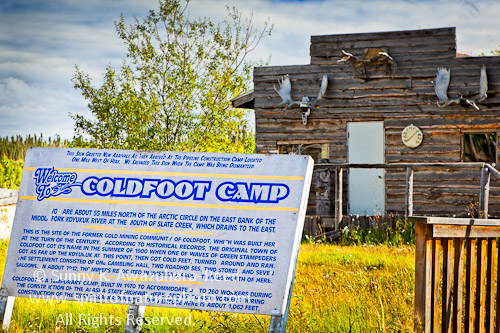
The historic gold rush town Coldfoot is now a big truck stop for huge trucks which heading to/from North Slope oilfield.  This is a last place for gas and supplies until Deadhorse, on the north end of Dalton Hwy.
The highlight of the Dalton Highway is north of Coldfoot; the spectacular Brooks Mountains begin. Gate of Arctic National Park & Preserve, Arctic National Wildlife Refuge, and some other protected lands are laid along the highway.  The colors of the tundra was vibrantly painted in orange and red, glowing in the nearly everlasting autumn sun.
Crossing Atigun Pass, the rivers north of the pass flow into the Arctic Ocean, and the rivers in the south flow into the Pacific Ocean. The dramatic scenery - rugged mountains and tundra valley continues on.
It was an emotional moment when I finally saw the edge of Arctic National Wildlife Refuge after signing so many petitions to protect this pristine remote land from oil development for the past years.  When I first heard about this area and the issue, I was still young, maybe a teenager in Japan, but I was strongly moved and felt pain for the political issue.  Finally I was there, seeing the evening light shine down upon the rugged mountains and the valleys from the Dalton Hwy...  The landscape of the refuge is stunning. I hope this area will be permanently protected for future.
Caribou crossing the tundra on north of Brooks Range.
The darkness of night lasts for at least a few hours...  The northern lights start dancing the Arctic.
To be continued to the next posting...

Saturday, August 25, 2012

Gray Wolf - Canis lupus

I know it's been an overdue update, my excuse is I've been taking many trips to Alaskan wilderness for photo projects. Summer in Alaska is short, I have to make the most out of it. I have mountains of photos to go through... Before editing hundreds of photos from each trip, I was already off to the next adventure.

Well, I'd like to share my first Wolf images, taken just south of Denali.
It was in mid June, after a long sunset at nearly midnight, finally dusk had come down in the interior of Alaska. I was heading north on George Park Highway to explore the isolated and lightly travelled Denali Highway. There was a dog-like animal crossing the highway in the twilight. As I got closer I realized it was a wild Grey Wolf!
 
He was standing right by the highway and staring at me as if he expected something...
 
A motorcycler stopping to photograph the unforgettable sight.

After a while, the wolf jumped back in the bush. There he was scavenging a Moose carcass only a several yards away from the highway. I kept pressing the shutter button for his up close! He occasionally would stare at me while he was intensely chewing the carcass, ready to defend his sustenance in a moment's notice. I could see the wild ferocity burning incandescently his yellow eyes.
 
Finally, he dragged a piece of Moose, and disappeared into the wilderness. It was one of the most special moments that Alaska's natural elegance has brought me thus far.

Tuesday, October 18, 2011

Denali (Mt. McKinley) from Cook Inlet, Anchorage

It was in early October, the weather was perfect for the weekend in Anchorage.  The sky was clear and the air was crispy clean.  I was waiting for a perfect sunset to dip behind the mountains across the Cook Inlet.  The rugged snow capped mountains: Mt. Susitna, Mt. Spurr, Mt. Redoubt, and Mt. Hayes were in outstanding backdrop!
Located 350 miles south of Fairbanks, Anchorage was 2-3 weeks behind, still in Autumn.  Fall leaves were still hanging on the birch trees, and the temperature was 10 degrees warmer than the interior of Alaska near Fairbanks, where I currently live.
The orange sun was slowly moving to the tips of the volcanic mountains.  Bright orange glare reflected on the calm water.  I was focusing on the dynamic landscape spread in front of me.  It took me a while to notice the high distinctively shaped snow covered mountain standing out in the northwestern horizon.  To my surprise, I realized it was the highest peak in North America, Mount McKinley (Denali)!  When it's clear enough, Mt. McKinley can be seen from 300 miles south in Anchorage!
The warm light from the setting sun glowed on the south side of Denali for a long while.  The colors were slowly changing to soft pink, and then fading out.  The western sky and the inlet were bright orange for awhile afterward.  Viewing Denali from the city was a surprising bonus for the day!

Thursday, September 22, 2011

Autumn Aurora

September has been a great month for the northern lights display.  Soon after darkness fell back in the northern sky, the aurora began appearing in the Interior of Alaska.  I've already seen the great aurora several nights in last few weeks.  As I understand it, when the sun's activity is high, it releases solar flares that impact with the atmosphere.  During those times, magnificent northern lights dance across the sky. 
 
The best part of viewing the northern lights at this time of the year is the weather is still mild.  It has been in the 30s - 50s; warm enough to be outdoors.  I dress with a light jacket and regular hiking boots unlike wearing a big heavy coat with layers inside, ski pants, and bunny boots at -20 degrees.  Waiting to see the aurora outside is much easier and more fun before serious winter arrives.
It was the night before the Harvest Moon, I was heading to a small lake where I planned to set up my camera.  The northern lights were already stretched across the zenith.  A nearly full moon lit up the trail all way to the lake.  The moonlight was incredibly bright; I didn't even need to use my flashlight on the trail through a birch forest!  Those autumn birch were glowing in orange- gold under the moonlight.

It was about 30 degrees, a bit of cold in the air.Mist drifted on the surface of the lake.The lake was still like a mirror, reflecting the autumn colored hill and stars.The whole surrounding was silent in this remote landscape.
I set up my camera and waited for awhile... the faint aurora was in the sky over the millions of stars...  After a while, more aurora showed up on the other side of the sky.  It was a faint white line in the beginning, then slowly brightened to neon green... then moving and waving into the horizon.  At one point, the pink/purple lights were blinking along with the main stream of neon green.  After the moving lights came down, faint green bands of lights appeared and stayed for a long time.  The fall-colored hillside was glowing under the bright moon.

It was peaceful...
surrounded by wooded hillsides
only the sounds of a creek...
under a clear sky with countless stars... 
The aurora was appearing and disappearing... 
I was alone in this silent dream.  That was one of the moments, I've felt closest to mother nature.

Wednesday, September 7, 2011

Autumn Falls on the Interior Alaska

In the 3rd week of August, some of the Birch leaves (Birch looks just like aspen) began turning yellow. Within a few days, the yellow color was spreading everywhere.  In the interior Alaska, the seasonal change comes very quickly!   It was only 3 months ago when fresh green over took the hillside; and while I was neglecting to upload new posts, the summer is already over!
 In early September, we are already in Autumn.  The surrounding mountains are covered with golden yellow leaves, and some of the small plants on the ground are turning to bright red.  Berries are ripe, the air is crisp, and there are many beautiful days in row!  Fall is another delightful season in Alaska.

The long daylight during summer gradually shortens...  Sunset is around 9pm at this time of the year;  We no longer have a "midnight sun."  The Northern lights have started dancing in the dark sky again...  Animals are urge to prepare for the coming winter...   Summer's ending is always sad.  At the same time, I'm excited as another Aurora season begins.
Here are some more fall colors images...